
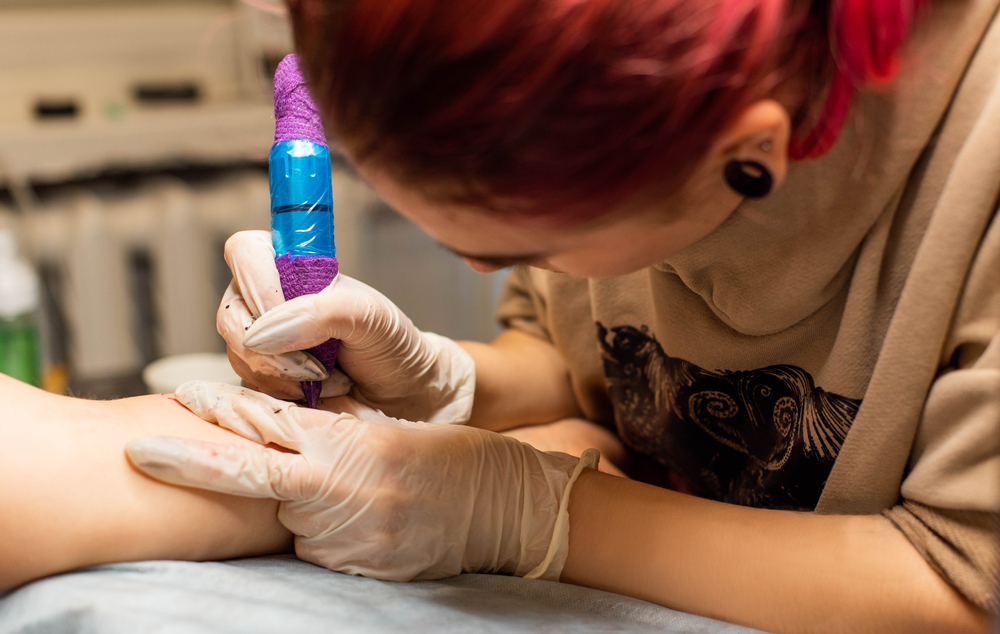
She walked out of her third tattoo removal session feeling fine.
Then she woke up the next morning and realized what she'd done to herself.
What she found – and then posted online against her sister's desperate pleading – is something 21 million Americans heading down the same road need to see first.
The Moment She Realized Something Was Very Wrong
TikToker Kyra Green thought she was being smart.
The 29-year-old Los Angeles influencer was removing a dark tattoo on the back of her knee – a cover-up of a previous tattoo she'd gotten for an ex-girlfriend.
During her third laser session, she felt her skin running hot.
She told her technician to amp up the settings anyway.
"I look down, and it starts to look a little bubbly," Green said in a now-viral TikTok video.
She went home.
The next morning, she discovered a blister the size of a lemon had formed on the back of her knee.
"It felt like a water balloon was attached to the back of my leg," she told People magazine. "I was terrified it would pop."
Green posted the footage online – despite her sister begging her not to.
"My sister said I absolutely should not share this on the internet because it's disgusting," Green admitted on camera, "and I agree with her, but I'm still going to show it to you guys because why not?"
The clip exploded.
Fans flooded the comments urging her to go to the emergency room.
Others – including dermatologists – stepped in to reassure her that massive blisters are a known complication of laser tattoo removal, especially on dense, dark, or cover-up tattoos treated at high settings.
The blister lasted a week before it finally popped.
Her mom came over to clean the wound and bandage it.
Several more weeks passed before it fully healed.
What the Experts Won't Always Tell You Up Front
Green's experience wasn't a freak accident.
Blisters after laser tattoo removal are a documented side effect – particularly common with dark ink, colored tattoos, cover-ups, and when technicians push laser intensity.
Each session delivers concentrated light energy designed to break ink particles into fragments small enough for the body to flush out.
That same energy heats the tissue, disrupts surrounding blood vessels, and can trigger the skin to wall off the damage with fluid.
When a tattoo is dense – or when a patient asks to push the settings higher – the reaction can be severe.
Green's tattoo hit every high-risk marker: dark ink, a cover-up layered over previous work, high-intensity settings at her own request.
Industry experts say blisters larger than a dime require lancing with a sterilized needle at the base to drain properly – not popping at home.
The skin over the blister must stay intact.
Remove it prematurely and you risk permanent scarring and discoloration.
What nobody tells you before you start is how many sessions it actually takes.
For a dark tattoo like Green's, technicians told her to expect six sessions or more.
"There's no way to fully know until you're in the process," she said, "since everyone's skin is different."
She has since paused her removal sessions to let her skin fully heal.
https://x.com/NahBabyNahNah/status/2036865025906737219“>https://x.com/NahBabyNahNah/status/2036865025906737219
21 Million Americans Are in This Same Line
Green's story went viral because she's not alone – she just had the nerve to show it.
One in four Americans with tattoos now regrets at least one of them, according to Pew Research Center.
That's roughly 21 million people.
The tattoo removal industry has exploded in response – and is projected to keep growing sharply through the end of the decade.
Laser removal typically requires seven to ten sessions for complete clearance.
Each session runs an average of $463.
By the end, removal costs roughly ten times what the original tattoo did.
And that's before accounting for complications.
The procedure mimics the aftereffects of a second-degree burn – without the permanent tissue damage, if done correctly and followed with precise aftercare.
Here's what nobody puts in the brochure: blisters are worse on tattoos near the extremities – hands, feet, backs of knees – because those areas have weaker circulation and heal more slowly.
Green's tattoo was on the back of her knee.
That detail alone made her more vulnerable before she ever asked for a higher setting.
It's about the moment you're 19 years old in a tattoo parlor, someone tells you it's permanent – and you say yes anyway.
Now those same people are older, wiser, and paying a painful premium to undo it.
Share this with someone who's about to make a decision they'll spend years and thousands of dollars reversing.
Sources:
- Kaitlyn Frey, "Woman Shocked When Tattoo Removal Procedure Causes Massive, Mysterious Blister on Her Leg," People, March 25, 2026.
- Katherine Schaeffer, "32% of Americans Have a Tattoo, Including 22% Who Have More Than One," Pew Research Center, August 15, 2023.
- "Blisters After Laser Tattoo Removal Treatments," Vanish Skin Aesthetics and Laser Tattoo Removal, April 28, 2025.
- "Blister Care," Removery, October 30, 2025.