Michigan canvassers admitted forging thousands of voter registrations for gift cards.
Declassified FBI files now show exactly how far up the decision went to bury it.
One name still blacked out in those files decided that nobody would ever face charges.
Canvassers Told FBI Agents They Faked the Names Themselves
President Trump released the files Thursday night during a primetime address on election security.
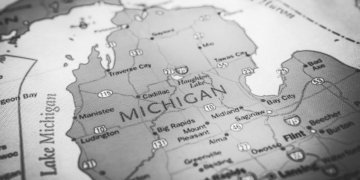
The documents concern GBI Strategies, a voter registration outfit that flooded Muskegon, Michigan with applications one month before the 2020 election.
Trump said the canvassers forged signatures under names that weren't their own and "received gift cards tied to their number of applications that they produced."
One canvasser told FBI agents that company leadership instructed employees to invent information whenever they came up short.
Another admitted he barely left his vehicle all day, jotting down a made-up name just to have something to turn in.
The Muskegon City Clerk's office first flagged the applications in October 2020, spotting nonexistent addresses and signatures that didn't match state records.
Michigan State Police and the state attorney general's office investigated, then handed everything to the FBI in 2021.
In Southfield, an FBI file describes a woman who never registered to vote but somehow got a voter ID card and an absentee ballot anyway.
That's when the Muskegon case disappeared into the bureaucracy for four years.
A Redacted DOJ Official Buried the Case Before It Ever Got Started
Start with the memo that started all of it.
In March 2021, a Justice Department Public Integrity Section official told the FBI the department would not "concur" with a dedicated investigation into the voter fraud itself.
That official's name is blacked out in every version of the memo the White House released.
Instead, prosecutors narrowed the entire probe down to debit cards used to pay canvassers.
By November 2021, the FBI's Detroit field office and federal prosecutors in western Michigan agreed to take no further action.
A database check of just twenty applications out of roughly ten thousand flagged as suspicious found that thirteen of them – nearly two out of three – were potentially fraudulent.
Seven contained completely fabricated information.
Four had a real name attached to a birth date, driver's license, or Social Security number that didn't match.
The Biden Justice Department had that arithmetic in hand and chose the debit-card angle instead.
The FBI's Grand Rapids office finally closed the file in September 2025, writing that "no further investigation is warranted" because every lead had been exhausted.
Trump directed FBI Director Kash Patel to reopen the investigation and coordinate with the Justice Department to prosecute anyone responsible.
What This Actually Tells You
Forget the spin about how the system worked because a few hundred bad applications got tossed before Election Day.
The system worked exactly how it was designed to work for Democrats in 2020 – catch it quietly, slow-walk it forever, and never let a canvasser see a courtroom.
GBI Strategies wasn't some rogue local operation either.
Michigan State Police records show the group collected $188,000 from the Democratic Senatorial Campaign Committee in 2018, and it ran the same registration drives in Benton Harbor, Inkster, Flint and Southfield.
A DOJ lawyer with the authority to greenlight a real investigation looked at FBI agents who believed crimes were committed and told them to stand down.
That's not oversight.
That's a decision, made by someone whose name is still blacked out in the very documents Trump just released.
Interviewing canvassers who already confessed does not take four years.
It only takes that long when the people running the Justice Department don't want the answer on the record.
Now the file is back open, the president is watching, and the redactions are the only thing standing between the public and the name of the lawyer who buried it.
Sources:
- Patty McMurray, "WATCH: President Trump Lays Bare Massive GBI Strategies Fake Voter Registration Scam in His Nationwide Address," The Gateway Pundit, July 2026.
- "Trump resurrects 'slow-walked' FBI 2020 election fraud investigation in Michigan: What we know," Washington Examiner, July 2026.
- "Memos reveal FBI faced roadblocks to prosecute possible 2020 Michigan voter registration fraud," Just the News, July 2026.
- "Declassified 2020 Election Docs Provide Key Intel Withheld From 'Flawed' January 2021 IC Assessment," American Greatness, July 17, 2026.
- FBI Grand Rapids Resident Agency closing memorandum, declassified and released by the White House, September 25, 2025.